
Information and inspiration for those who support dyslexic learners
For more than a decade Studying with Dyslexia has been a trusted place for people who support dyslexic learners. We share guidance, insight and inspiration to help educators, parents and individuals understand dyslexia and the wider neurodiverse world with confidence. Through articles, resources and community spaces we bring people together to learn, to share and to feel supported on every step of the journey.




Why might a dyslexic student refuse to use assistive technology?
It can be frustrating when we try to help a dyslexic student and they seem to refuse to accept it. Why is this the case and what can we do to help win them over?
Dyslexia Support: How to understand more, reduce overwhelm and help your child to thrive.
At time of writing it is August 2021 and the Autumn Term is not far away. Whilst we do what we can as parents to enjoy the summer and help our kids to relax, we know that there will be challenges coming up in the new term regarding how our school and colleges support...
Why is the JCQ NOT ensuring that exam papers are accessible for dyslexic students?
Why won’t the Joint Council For Qualifications bring about dyslexia friendly exam papers using the British Dyslexia Association Style Guide? Mum, Alex Castle is trying to change this with her petition that has gone viral!
How can parents improve their child’s speech and language skills?
Difficulties with speech and language skills can be so obvious to the people around children. What can we do as parents to help? Start by downloading this resource that gives great tips, of course!
Should my child be excused from learning languages at school?
With dyslexia being a language disorder, shouldn’t pupils with dyslexia therefore be excused from studying further languages? What should we as parents be considering?
Building Summer Self-Esteem
This week herald’s the end of the academic year and the start of the clock ticking for the new one. Helping your child to develop their positive sense of self-esteem has never been more essential. I share three tips for parents to use to boost summer self-esteem.
Join for the Latest Updates
A trusted source of information, inspiration, support and community for everyone who supports dyslexic learners.
Studying with Dyslexia is built around 4 core areas: Information, Inspiration, Support and Community. These areas shape the content we share, the conversations we encourage and the support we offer to educators, individuals, support professionals, families, parents and the wider community.

Information
Clear explanations about dyslexia, learning, study and neurodiversity.
Helping people understand what dyslexia is, how it can shape learning, and how strengths and challenges can show up in different ways. Making important ideas feel clear, accessible and useful for educators, parents, individuals, everyone supporting dyslexic learners and the wider community.

Inspiration
Understanding lived experience, positive examples and stories that build confidence, encouragement and possibility.
Sharing real experiences and reflections that help people feel seen, valued and understood. Showing how dyslexic learners can recognise their strengths, navigate challenges and feel more confident in their learning journey.

Support
Practical strategies, tools, study ideas and resources that help dyslexic learners thrive.
Providing clear and practical support that helps people take meaningful steps in understanding and supporting dyslexic learners. Sharing useful strategies, tools and resources that can be used in education, at home, in study and across the wider learning journey.

Community
Shared understanding, meaningful questions, discussion, sharing knowledge and learning from each other.
Building positive spaces where educators, individuals, support professionals, families, parents, everyone supporting dyslexic learners and the wider community can connect, share and grow together. Encouraging supportive conversations, shared experiences and community learning that help people feel understood, included and part of something bigger.
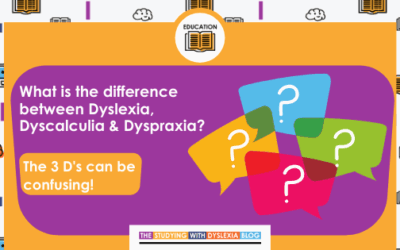
The 3 ‘D’s’ : What is the difference between Dyslexia, Dyscalculia and Dyspraxia?
Do the terms Dyslexia, Dyscalculia and Dyspraxia confuse you? Read this article for some clarification on what these conditions are and how they present.
Does remote learning require a review of reasonable adjustments for your dyslexic learner?
I want to hear from you if your child’s reasonable adjustments have become inappropriate now that your child is remote learning. Please share this article.
How to do remote learning: Tips from parents.
In this article, parents of dyslexic children share their thoughts on remote learning during Lockdown 3.0 with some useful tips.
Understanding the interaction between DCD (Dyspraxia) and Dyslexia: Should schools teach PE differently?
Physical Education is great for some and not for others. Are our PE teachers doing enough to help children with SEN to understand how their bodies move, build their confidence and their engagement at school?
How to help your dyslexic child improve remote learning during “UK Lockdown”.
It is #UKLockdown 3.0 and parents are back to helping their children with remote learning. I want to share this excellent resource with you which shares tips in how to make remote learning for your dyslexic child more fruitful.
How to support the emotional development of our dyslexic learners.
In this article I want to explore the concept of psychological projection, and how we can avoid hampering our children’s emotional development by keeping our own ability to project emotions in check especially whilst changes to how our children learn seem to be happening on a daily basis!
Christmas 2020 is wonky! Let’s do something great together!
Christmas 2020 has gone a bit wonky!
Usually, I would write a Christmas greetings blog article at this time of year but I feel sad about Christmas whilst we are experiencing the pandemic here in 2020. So I want to do something different…. Join me and help me to help LadBaby get to Number One so that families across the UK can get the food that they need during this difficult time.
Three tips for dyslexic learners for effective learning from home.
In this article I am going to share with you 3 tips for effective learning from home that dyslexic learners can use to help boost their attainment.
How to inspire a love of reading despite dyslexia.
How can we inspire our dyslexic learners to love reading when so often it can seem tiresome and stressful? ICT teacher and inclusion mentor, Carol Allen shares her thoughts as she is interviewed by SENCo, Julia Clouter from Succeed With Dyslexia.